
ENGINEERING EDUCATION
Understanding Engineering Education Worldwide
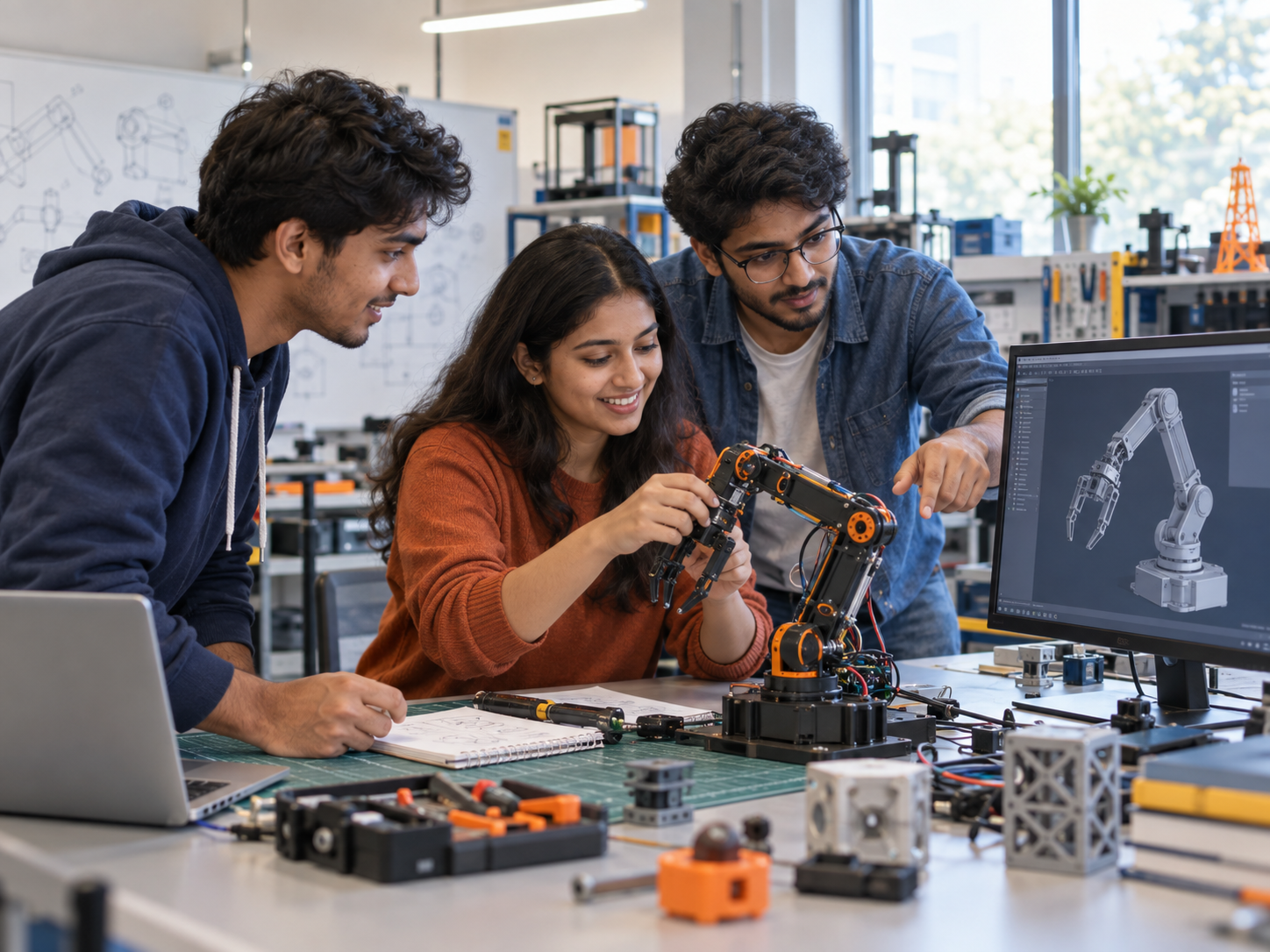
Engineering education is built for the world
Engineering is the backbone of modern civilization from technology and artificial intelligence to infrastructure, energy, healthcare systems, and space exploration.
It is one of the few career domains that is universally standardized and globally transferable, making it a top choice for students aiming for international careers.
Across countries, engineering education follows a standardized academic structure, focusing on problem-solving, technical knowledge, and practical application. While degree titles and specializations may differ slightly, the core curriculum, skill development, and industry exposure remain consistent globally.
Scientific & Mathematical Foundations
Build the scientific thinking every engineering discipline relies on.
Practical Problem-Solving & Innovation
Turn knowledge into creative, testable solutions to real problems.
Industry Training & Real-World Application
Learn with the tools, teams and applications used by industry.
GLOBAL RECOGNITION
What Makes an Engineering Degree Globally Accepted?
AICTE
Accreditation by bodies such as the All India Council for Technical Education.
WASHINGTON ACCORD
Alignment with global engineering education agreements and outcomes.
EMERGING TECH
Curriculum designed with industry relevance and emerging technologies.
APPLIED LEARNING
Strong emphasis on internships, projects and applied learning.
YOUR ENGINEERING JOURNEY
Engineering Education Follows a Structured Progression
01
Foundation Phase
Mathematics (Calculus, Algebra, Statistics)
Physics & Basic Sciences
Engineering fundamentals
02
Core Engineering Phase
Branch-specific technical subjects
Analytical and design-based learning
03
Practical & Training
Workshops, simulations, lab experiments
Software tools and engineering applications
04
Industry Exposure
Internships
Industrial visits
Live projects with companies
05
Specialization & Projects
Final-year capstone projects
Research or innovation-based work
06
Career / Higher Education Path
Job placement
Postgraduate specialization (M.Tech / MS)
UNDERGRADUATE ENGINEERING
B.Tech / B.E — Foundation of Engineering Careers
Duration
4 Years
Eligibility
10+2 with Physics, Chemistry & Mathematics JEE Main / JEE Advanced / SAT
Global Availability
India, USA, UK, Canada, Australia, Germany and Europe.
Mechanical & Aerospace Group
Design, analysis and manufacturing of moving parts, machinery and thermal systems.
- Mechanical Engineering: Thermodynamics, robotics, manufacturing and automotive design.
- Aerospace Engineering: Aircraft, spacecraft, satellites and missiles.
- Automotive Engineering: Cars, trucks, motorcycles and their systems.
- Marine / Naval Engineering: Ships, submarines and offshore platforms.
- Mechatronics Engineering: Mechanical engineering, electronics and computing for automated systems.
Electrical, Electronics & Computer Group
Electrical energy, electronics, computing architectures and software systems.
- Electrical Engineering: Power, grids, heavy machinery and renewable energy.
- ECE: Microchips, semiconductor devices, telecommunications and satellites.
- CSE: Algorithms, software, data science and AI.
- IT Engineering: Network security, databases and information infrastructure.
- Instrumentation & Control: Measuring and controlling automated processes.
Civil, Structural & Environmental Group
Shapes infrastructure, transportation networks and environmental safety.
- Civil Engineering: Roads, dams, bridges and water systems.
- Structural Engineering: Buildings and bridges that withstand loads and forces.
- Environmental Engineering: Pollution control, waste, water purification and sustainability.
- Geotechnical Engineering: Soil, rocks and underground foundations.
- Transportation Engineering: Highways, mass transit, airfields and ports.
Chemical, Biological & Materials Group
Works at the microscopic level with molecules, chemicals, living cells and materials.
- Chemical Engineering: Raw materials to products through chemical processes.
- Biomedical / Bioengineering: Prosthetics, medical devices and artificial organs.
- Materials Science: Polymers, ceramics and nanomaterials.
- Petroleum Engineering: Oil and natural gas exploration and production.
- Agricultural / Food Engineering: Crop production, food safety and processing machinery.
Industrial & Specialised Management Group
- Industrial Engineering: Efficiency, waste reduction and supply chains.
- Mining & Metallurgical Engineering: Mineral extraction and metal processing.
- Nuclear Engineering: Nuclear power, medical radiation and waste management.
- Systems Engineering: Large-scale complex engineering projects across their lifecycle.
B.TECH / B.E LEARNING EXPERIENCE
Learn the Theory. Build the Capability.
Curriculum Structure
- Years 1–2: Foundation & Core
Mathematics, basic engineering, programming, mechanics and electrical basics form the technical base. - Years 3–4: Specialisation & Application
Advanced branch subjects, electives, industrial training, simulations and final-year projects bring learning into practice.
Students develop both technical knowledge and real-world application skills — a combination valued by employers worldwide.
Practical Exposure & Skill Development
Engineering is hands-on. Students gain experience through:
- Laboratory experiments and workshops
- CAD, coding and simulation tools
- Industrial internships
- Team-based projects
- Innovation and research activities
These experiences make graduates job-ready from day one.
Career Outcomes After B.Tech / B.E
Software Developer / Engineer
Core Engineering Roles
Data & AI Engineer
- Entrepreneur / Start-up Founder
- Higher Education: M.Tech / MS
UNDERGRADUATE ENGINEERING
M.Tech / M.E - Advanced Specialisation & Research
Key Highlights
- Duration:
India: 2 years
Abroad: 1–2 years - Eligibility:
B.Tech / B.E degree
Entrance exams: GATE / GRE
High-Demand Specialisations
- Artificial Intelligence & Machine Learning
- Data Science & Big Data
- Robotics & Automation
- Structural Engineering
- Renewable Energy Systems
- VLSI & Embedded Systems
Learning & Training Structure
- Advanced technical coursework
- Research thesis / project work
- Industry collaboration
- International exposure
Career Outcomes After PG
- Senior Engineer / Specialist
- Research Scientist
- Product Manager / Tech Lead
- R&D Engineer
- Academic & Teaching Careers
Global Career Pathway in Architecture
Typical Career Path
Complete B.Tech / B.E
Gain internships or entry-level experience
Register with a professional body where required
Pursue M.Tech / MS (optional but valuable)
Move into senior, leadership or innovation roles
Why Choose Engineering?
Globally recognised and transferable degree
High demand across design, construction and technology
Opportunities in cutting-edge fields
Strong scope for innovation and entrepreneurship
Flexibility to work across residential, commercial, industrial and public projects
Important Note for Indian Students
- PCM is mandatory for engineering pathways
- JEE Main is the primary entrance for India
- Choosing the right branch is more important than just the college
- International degrees provide exposure to advanced research and global job markets
Start Your Architecture Journey
Shape the future with innovation, technology, and global opportunities.
- UG Engineering (India & Abroad)
- PG Specialization (M.Tech / MS)
- Career Guidance & Admission Support


